
Recent Scientific Evidence: Advances in Traditional Chinese Medicine for Current Clinical Practice
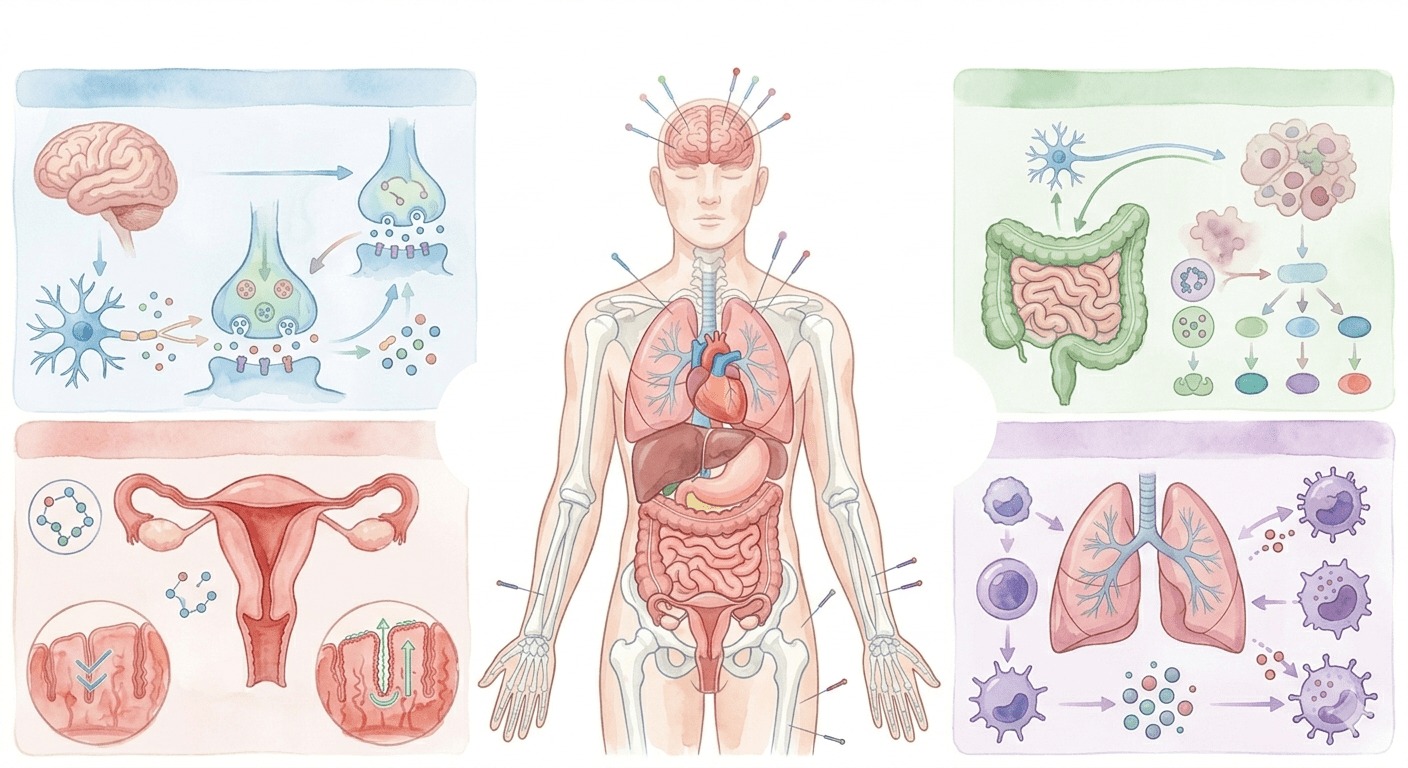
In recent years, Traditional Chinese Medicine (TCM) has undergone an unprecedented process of scientific validation. According to the technical report from the Acupuncture and TCM Observatory of the Natural Therapies Foundation (OAMTC), there are currently more than 28,000 indexed references in MEDLINE that support the efficacy of acupuncture, with a growing trend towards high-quality research in this 2024-2025 biennium (García et al., 2025).
Below are the advancements segmented by pathologies and symptoms, citing key sources and organizations.
Neurology and Pain Management Migraines and Chronic Headaches
Acupuncture has established itself as a first-line intervention for the prevention of migraines. Recent research highlights its ability to modulate neuronal sensitivity and reduce the inflammatory response in the brain.
Evidence: Reviewed studies by the International Journal of Acupuncture indicate that the treatment not only reduces the frequency of attacks but also improves the quality of life superior to certain preventive pharmacological treatments (García et al., 2025).
The effectiveness of acupuncture in migraines and chronic pain is explained through two main mechanisms:
GCTGate Control TheoryThe stimulation of large-caliber nerve fibers (A-betainhibits the transmission of pain signals in the spinal cord (Melzack & Wall, as cited in Lesson 7, n.d.).
Fibromyalgia and Musculoskeletal Pain
The current approach focuses on the modulation of the neuroendocrine sistemStimulation of specific points has been shown to help regulate central sensitization mechanisms (García et al., 2025).
Mental Health and Digestive Disorders:
The Gut-Brain Axis
One of the most innovative fields is the use of electroacupunture (EA) to simultaneously treat affective and digestive disorders, supported by institutions such as the Autonomous University of Baja California (UABC) and CONACyT.
Depression and Anxiety:
The use of EA in points such as Baihui (Du 20) and Shenting (Du 24) has shown a significant reduction in depression scales from Hamilton, acting through the CaMK signaling pathway (Vique-Sánchez & Galíndez-Fuentes, 2021).
Irritable Bowel Syndrome (IBS):
Research highlights that stimulating the Zusanli (ST 36) point regulates intestinal motility and decreases systemic inflammation, making it a key tool for patients presenting with mixed signs of stress and constipation (Sebastián Domingo, 2017; Vique-Sánchez & Galíndez-Fuentes, 2021).
Woman's health
The International Journal of Acupuncture (Elsevier) has published critical studies in 2024 on the role of TCM in hormonal health.
Fertility: The investigation of 2024 published on the International Magazine of Acupunture points that acupunture improves the endometrial receptivity by increasing uterine blood flow through the inhibition of central sympathetic activity. This optimizes levels of estradiol and progesterone, facilitating implementation in assisted reproductive technologies (Pacheco Engler & Magalhães Rodrigues, 2024).
Health and Breast Cancer: Research from 2024 highlights the potential of acupuncture to improve mental well-being in breast cancer survivors, helping them manage side effects of cancer treatments (Cruz et al., 2024).
Immunity and Post-Infectious Recovery
In the wake of the pandemic, scientific organizations have focused their efforts on studying functional recovery.
Post-COVID-19Acupunture shows be a value tool on treatment for acute and persistent COVID-19 syndrome, helping to alleviate chronic fatigue and residual respiratory disorders (Soares Bernardo & Magalhães Rodrigues, 2024).
Bibliography and Reference Sources:
Cruz, G., Fonseca, M., Silva, R., Torres, R., & Rodrigues, J. M. (2024). Acupuncture and its potential in enhancing mental well-being for breast cancer survivors: An evidence-based insight. Revista Internacional de Acupuntura, 18(100297). https://www.elsevier.es/es-revista-revista-internacional-acupuntura-279
García, M., Francisco, E., Llopís, M., Araez, J., De Alba, M., Vilar, E., Pérez, Y., & Navas, G. (mayo, 2025). Estado actual de la investigación y evidencia científica en Acupuntura/MTC. Parte I. Observatorio de Acupuntura y MTC (OAMTC). https://practitioners.mtc.es/evidencia-cientifica-acupuntura-mtc.php
Pacheco Engler, E., & Magalhães Rodrigues, J. (2024). Acupuncture in reproductive health: Evaluating its potential as an adjunct therapy. Revista Internacional de Acupuntura, 18(100296).
Soares Bernardo, P., & Magalhães Rodrigues, J. (2024). Acupuncture in acute COVID-19 treatment: A review of clinical evidence. Revista Internacional de Acupuntura, 18(100298).
Vique-Sánchez, J. L., & Galíndez-Fuentes, A. I. (2021). Acupuncture as a complementary medicine for depression caused by the confinement by COVID-19. Revista Internacional de Acupuntura, 15(100148). (Estudio extendido con apoyo de CISALUD-UABC y SNI-CONACyT).